Showing posts with label research questions. Show all posts

Monday, April 23, 2012

Vitamin A Deficiency Affecting Diseases

Hurray, hurray, hurray! I've been fighting vitamin A deficiency for almost 2 years now, to no avail (discussed in Huge Vitamin A Deficiency). Candida destroys vitamin A, but then also many of the candida killers I was using (oregano oil, grapefruit seed extract and I strongly suspect Barlena's Olive Leaf extract) also destroy it. I tried taking large doses of vitamin A in oil gels and later in the dry form, but had no results. Then I bumped into a passage in the book Supplements Exposed that said that taking the supplement vitamin A will not boost vitamin A but will actually impair it. I had just gone through a lot of vitamin A gels and thought I'd test that theory, because I didn't know what else to do. So for the two months almost every day I gobbled up more high potency vitamin A capsules (the dry kind this time), retested, and yup, the outcome showed virtually no change. I know that vitamin A needs iron, oil and other nutrients in order to become assimilated well so there might be other underlying problems why I didn't absorb any of the nutrients. So, I decided I would do it solidly through a diet saturated in vitamin A-rich foods.

So for the past 2 1/2 months I have been taking large doses of Pure Hawaiian Spirulina Pacifica, rich in vitamin A among other large doses of immune building nutrients like vitamin K for the bones and heart, vitamin B12 which vegetarians and vegans especially need, iron which is so important for women, and 2 trace minerals, manganese and chromium. [On the Hawaiian spirulina label the suggested amount is 1 teaspoon up to 3 times a day. I took 1 heaping tablespoon once a day.]

Ah, synergy of vitamins in their natural state and working in correlation with one another rather than just the isolated vitamin A in supplement form! Almost every morning I ate 2 tablespoons of chia seeds [the packaging suggests 1 tablespoon a day and elsewhere I've read to not eat this daily beyond one month as side effects are unknown]. The chia seeds are said to be rich in vitamin A (I've never found out nutritionally how rich though, but hey, I can't eat the vitamin A-rich foods like carrots, winter squash, sweet potatoes and other highly glycemic foods so I just went with hearsay on this). Anyway, my wonderful vitamin A outcome just came back .... NORMAL!!!!

January 20, 2012 - my outcome at .18 (extremely low!)
April 3, 2012 - my outcome at .42 (.30~.70 is normal)

That's a whopping increase of .24 in just 2 1/2 months!!! The last 2 1/2 months I've really gobbled up tons of vitamin A-loaded asparagus too, tried to include a little oil in each of my green smoothies to help with vitamin A assimilation, and faithfully drank my spirulina and ate chia seed pudding. Yes! Finally!

And just a comment on that "normal" range above for vitamin A. I've been testing at the same clinic (a testing practice which assures a more standard reading of test outcomes) for the past 2 years, and until just a few months ago, the "normal range" for vitamin A listed on test results print-outs was .36~1.20. However, about 6 months ago that range got drastically shifted, and shockingly the "norm" for vitamin A was reduced! The "normal range" now reads .30~.70. I can understand why the range was lowered - there is great fear of vitamin A toxicity, and in fact, many of the symptoms for toxicity and for low vitamin A are the same. Go figure that one out! But for the range to actually be lowered indicates to me that the USDA/FDA/who? is becoming more accepting of the lower and lower numbers of vitamin A and is accommodating their figures to match the common, a.k.a. "normal", populace. A big study on this needs to take place.

Vitamin A Deficiency Affecting Diseases

Animal Pharm, a site dedicated to blogging about nutrition on global issues, detailed a list of diseases that low vitamin A plays an instrumental part in. But before I reintroduce the list, the site also presented that the marbling of meat - human abs, glutious maximus and biceps as well as beef - is a direct cause of insufficient vitamin A in the body. Now everybody wants to present tight shapely muscles, and yet people tend to go for the choice cuts of well-marbled meat. These two desires are in direct opposition of each other and reflect two opposing standards. Humans have the standard of desiring no marbling in their own muscles (and therefore, have the unknown desire to have adequate amounts of vitamin A) while they desire the appealing look of well-marbled meat, a grade A cut (which unfortunately could be an indication of a vitamin A deficiency in the meat, and therefore in actually a substandard cut!). This blog entry is a must read!

Now, for the diseases that result in vitamin A deficiency or possibly are a partial result of vitamin A deficiency...

Who might be vitamin A deficient?
..... vegans
..... those who eat 'low fat'
..... those who don't consume a lot of wild seafood/grassfed meat
..... children less than age 4 and women
..... those with cancer
..... chronically ill
..... those with infections or high CRP (chronic restrictive pulmonary)
..... those with Hashimoto's hypothyroidism
..... those with other autoimmune diseases: Grave's, RA (rheumatoid arthritis), SLE (systemic lupus erythematosus), Sjogrens, MS (multiple sclerosis), NASH (non-alcoholic steatohepatitis), primary biliary cirrhosis, CAD (coronary artery disease), etc
..... those with skin conditions (again, autoimmune origin and wheat-triggered): eczema, rosacea, skin cancer, poor wound healing, atopic dermatitis, psoriasis, dermatitis herpetiformis, porphyria cutaneous tarda
..... those with gluten enteropathy, (known vs. unknown) wheat/casein allergies, 'leaky gut' and a poor intestinal barrier which prevent absorption of fat and fat-soluble vitamins
..... those without a gallbladder who may not produce sufficient digestive enzymes to absorb fat and fat-soluble vitamins
..... those who take Orlistat/Xenical or OTC Alli (weight loss pills which block fat and thus fat-soluble vitamins A, D, E, K1, K2)
..... those on antiseizure drugs (valproic acid, carbamezepine, phenytoin which increase metabolism/elimination of vitamin A)
..... those who have had gastric bypass which unnaturally cuts out a great portion of our most important absorptive surface area for fat and nutrients, the duodenum
..... diabetic-induced rats fed vitamin A deficient lab chow
..... Inuit children with frequent lower respiratory tract infections and otitis media [the children are probably no longer consuming their traditional H-G-fish Paleo diets but the S.A.D. (standard American diet) grain-based one like Americans]
..... third world countries where night-vision blindness is prevalent

Monday, March 19, 2012

Water Testing with Precipitator: SamDaSoo vs. Chungho Water

Another person, my friend L, responded to my cry of desperation on Facebook related to my reaction to bottled water. L wrote in my inbox that her husband had a precipitator which tested the purity of water and that I should come over right away and test my water. Some time during this morning after I left home, we decided that I should go over to her house today. I went but didn't have a chance to also get a sample of water from my own kitchen and another from my Brita water purifying jug that in desperation I bought at Costco yesterday.

Ergh, I do NOT want to drink tap water that has been "purified" through the little portable Brita jug. I don't trust the purification system, and think the city tap water is too horrendous here in Seoul, especially where I used to live (thank goodness I finally could move in February!). Anyway, I don't want to put tap water in my fragile system as THAT was what initially blew my system -- drinking city water, the divine Arisu that is marketed by our Korean President Lee Myung-bak as drinkable but which made myself and my two cats very sick (one cat died and Aulait and I have been sick sick sick since).

Anyway, my friend L picked up a new bottle of SamDaSoo at a local store and we went to her house to test it against her water from her reverse-osmosis Chungho water purifier.

To use the precipitator for best results, the water needs to be at room temperature. If it's cold, the results won't be accurate as the activating prongs need to heat up the water to room temp before the actual testing may begin. If water is contaminated, the water continues to heat up based on the number of minutes the precipitator is set at. We set the precipitator timer for 5 minutes but in less than 45 seconds a clear difference in the quality of water between the bottled SamDaSoo (left) and the reverse osmosis Chungho water (right) was obvious! If the water is relatively uncontaminated as the Chungho water appears, then the water does not heat up much beyond room temperature ... and the Chungho water didn't whereas the SamDaSoo was getting steadily warmer, and very steadily grosser, Grosser, GROSSER!


The printout for diagnosis of the quality of water based on its color after using the electrolosis devise was in Korean so I had to bring it home to translate.


YELLOW - nutrition (amino acids, organic minerals, 용존oxygen, pure water molecules), nature-born organic matter

WHITE - lead, zinc, mercury/quicksilver

BLUE - copper pipe rust, arsenic, mercury/quicksilver, lead, copper, sodium/natrium

BLUE - germs/bacterium, carcinogenic natural matter, gas

RED - iron/steel bacterium, rust water, iron water

BLACK - heavy metals (zinc, lead, copper, chromium, phenol/carbolic acid, manganese, etc)

YELLOW is the indicator for water registering contaminants under 10ppm and therefore is safe to drink.


Analysis of SamDaSoo Water

Now based on the 5-min electrical activation of the SamDaSoo water as shown here, the colors of the water do not appear to fall anywhere near the safe zone. In fact, very far from it! The water had a scum on top of it that seems to fall under "BLACK" which signifies heavy metals. The water itself is white and colorless. That seems good from a lay-person perspective since the bottle has a 2-year stamp for company considered safe shelf life. But yikes when you consider it! Is the company so confident that no bacterium is in the water and will grow in those 2 years?!?! And just WHAT did they do to the water that would give them such company-product confidence? But now to analyze the "WHITE" - lead, zinc, mercury. OK, we're talking heavy metals a-g-a-i-n!!!!!

Now if we were to analyze this a bit closer, we could cross-compare the disgusting water results with that from a Ionic Detox Foot Bath, which also uses some kind of electrolysis. Foam is not mentioned at all on the chart above but white foam did appear on the SamDaSoo water. What does this signify? And do the two electrolysis tools have overlap in what the gross water appearance tells of the chemical make-up of what is in the water? Hmmm ...

Sunday, March 18, 2012

Reaction to Bottled Water (Headaches and Numbness)

In January I started to feel poorly again. I didn't really understand but thought maybe it had to do with being bored as I didn't have winter work so I wasn't getting as much exercise as when I'm running around teaching and with papers to grade while trying to accomplish a lot during the week. I was starting to have weird headaches and low energy too. In Februrary I went home for two weeks and felt really good while at home (seems natural!). The headaches disappeared, the achy feeling in my back let up, and I had more energy. OK, I was going home, but still, I didn't exercise much at all at home. It was cold outside and my aging parents are becoming more and more housebound in the winter so we pretty much had a low-energy, low-key 2 weeks together (not my choice of lifestyle). In March when I came back, the headaches started again - mild at first but getting more and more noticeable. Odd, because I've never been one to have headaches and my diet was careful and good.

Then this past week, hell really started. The headaches became really bad and my arms became numb - 5 long days of numbness with the intensity varying throughout the day. I'm not sure when the numbness started as I've had arm problems (pinched nerves, reaction to sugars, swelling at the wrists ...) off and on since this Candida struck. I just try to ignore it if I can, but I've never really experienced anything like this ... numbness in my arms that lasted for days and days and days??? It's been really bad all week, horrendously bad, and to the point where my hands became very weak, especially the left, and it was hard to type, or even hold things. Yesterday was probably the worst - I was walking across my kitchen room with a half-eaten bowl of soup and the bowl just slipped out of my left hand ... SHATTER and SPLAT! My hand didn't even register it slipping!

Then last night before I called my parents I picked up a bottle of Korea's best bottled water, SamDaSoo, what I've principally been drinking since January, that is, since I was on winter vacation and didn't go to work every day and have filtered water, and also because in February I moved away from the subway line and so no longer felt like carrying a bottle of filtered water home every day after work. Anyway, I picked up the bottle and took a good chug on it before calling my mom and another huge headache hit and within seconds numbness descended into my arms and down my back. I REALIZED THE NUMBNESS IS CAUSED BY THE BOTTLED WATER, SAMDASOO. After we talked on the phone, I thought I'd try another bottled water, Seoksu, which I had bought that afternoon. It was so much cheaper so I thought I'd test it out. SAME THING WITH SEOKSU - BIG HEADACHE AND NUMBNESS DOWN THE ARMS!

Yesterday morning before going to church, I posted on Facebook the problem of the numbness caused by bottled water, Samdasoo and Seoksu, and if anyone knew where I could get testing. A colleague (thankfully!!!) did some research for me and suggested that my symptoms fall under arsenic poisoning and that arsenic has been located at toxic levels in many water sources - tap and bottled - throughout the world. On the first website he suggested, I found this statement that matches my symptoms: "When someone is suffering from arsenic poisoning, he or she may first experience headaches. Later, headaches will transform to a lightheaded sensation. Numbness and a tingly feeling in the hands and feet may also occur at the onset of poisoning."

He also wrote: "Arsenic poisoning is a medical condition caused by elevated levels of the element arsenic. The dominant basis of arsenic poisoning is from ground water that naturally contains high concentrations of arsenic. A 2007 study found that over 137 million people in more than 70 countries are probably affected by arsenic poisoning of drinking water.[1] from wikipedia. Seems very possible it can come from drinking water, and from the link above your symptoms match some of the signs."

Then he explained a little about tap water and bottled water: "Although more often found in contaminated ground water, it's also well known that bottled water is no better than tap water in many cases. Often just repackaged tap water with some minor chemical treatments and sold at a profit. There are numerous articles about that." The site he suggested that I read more on is titled "Bottled Water Not Better".

Arsenic poisoning does make sense on another level. In my hair analysis test of January 30 this year, arsenic did register as a toxin. I've never had arsenic show up on my two previous tests, each about 10 months apart. But on this last test, arsenic was the toxin that registered the highest in my body. It registered in the "low range" at 0.102 with 0.3 registering as high ... but for it to show up where it has never registered before does create cause for some concern considering the symptoms.

Yikes! I'm ordering an arsenic poisoning water test kit and testing both my house water AND SamDaSoo so I can perhaps KNOW why I'm reacting so terribly. This is not living!!!

Wednesday, February 1, 2012

Lyme Disease, Babesia and Candida

A friend who's been long-term sick (30 years) just told me that her sickness is from Lyme Disease and a co-infection of Babesia. When I last talked with her 1 1/2 years ago, I don't think she had diagnosis, so hurray that now she can address the specific problems. As I had never heard of babesia, I did some web searching, and found that like lyme disease, babesia is a bacterial infection [although some people argue that viral conditions can exist]. Searching further, the recommended diet for lyme and babesia is gluten-free, dairy-free and sugar-free. Well, that pretty much sums up the core of the candida diet, another bacteria-borne illness.

While at Wildwood Lifestyle Center & Hospital where I went when things went wa-ay out of control, I asked how they could treat Lyme disease as a good friend in Korea was diagnosed with that when she was three months pregnant. By the time the much-awaited baby arrived, she was very ill. We reconnected when her son was about three years old [2 1/2 years ago] and my friend was in a bad, bad, bad situation. She was extremely weak and highly excitable to the point of retreating to the couch to pant for the majority of the afternoon. She was exhausted and obviously her adrenals were exhausted too. [By the way, after spending one year in the states with her parents and extended family, eating a less acidic diet, and constant love around her, she recently told me that she's getting better and better, and seems to be entering some kind of remission!] At the lifestyle center, they told me that lyme disease is treatable with diet and herbs, but of course the success of the treatment depends mostly on how long the person has had the disease.

I didn't ask which herbs were used to treat lyme's and now I regret it. Candida, which is a bacteria overgrowth of bacteria which can become mold-like and fungal, can be treated with several herbs - oregano oil, grapefruit seed oil, thyme and many more. I would be interested to know if these three bacterial diseases (candida, lyme's and babesia) could be treated with the same herbs ... my guess is yes, but I'm not finding much herb treatment for either Lyme's disease or babesia on the internet [am very interested in pursuing this!]

Thursday, January 19, 2012

Soaking and Washing Nuts

Soaking toxins and mold off of nuts before eating them is absolutely important for the person with candida (even cancer for that matter as the liver in both groups is compromised and too inundated with bacteria and cell waste. I've read that the liver cleanses well over a liter/quart a minute! That puts a lot of cleansing demand even on the healthy liver!!!)

Since I've been following the soak and wash method for all my nuts, wow, I have been able to enjoy them again [principally almonds and walnuts, brazil nuts sometimes, and rarely for a treat, cashews]. So I bought a dehydrator for my family back in the States so my dad and my bro, who has nearly identical problems as myself, can also enjoy the clean, crunchy taste. Hurrah! After dehydrating the first batch, my dad started really chowing down on nuts [they are crunchy clean but break up much easier against his old teeth and dentures - which he loves - but the flavor is intensified and clean, which is wildly "nuts" about! So, he munches on them now instead of other sweet "goodies" and feels oh, so much better! I think the high protein in nuts has really helped him manage his Parkinson's tremors better; and btw, he was the first to say that :)

So, here's the method. The nuts first have to be washed in water until the water is colorless or debrisless. Walnuts are the nastiest nuts to wash, and will take several full immersions and rinses (10-15 times) to get clean. Almonds will color the water some but usually submerging and rinsing them at least 5 times will be enough. By the way, the almonds pictured below are the cleanest almonds I've ever washed. Usually the water is more discolored, sometimes murky even - and to think I used to make such huge demands on my liver by eating moldy, pesticide-packed nuts! [Also, because I want to eat my nuts with the highest enzyme count, I don't wash my nuts in water that is over 118°F - less is better - and the same applies for dehydrating them. I dehydrate at 115°F for usually 2 days, or until completely dry.]


The suggested soak time is as follows. The principal of soaking is to neutralize enzyme inhibitors in the skin of the nuts, particularly true of harder nuts like almonds, and to neutralize the phytic acid, which inhibits the absorption of minerals. Soaking also breaks down gluten [I want to study more about this] and facilitates the body in absorbing the vitamins. The harder the nut, the longer the soak time, and so here are some suggested soak times. For more info, read the Raw Food Living article although this article focuses on soaking nuts for sprouting, not eating immediately or dehydrating.


almonds ........... 8 - 24 hours
brazil nuts ....... 1 - 3 hours
cashews ........... 2 - 3 hours
flax seeds ........ 30 min - 6 hours
pumpkin seeds ..... 4 - 6 hours
sunflower seeds ... 4 - 6 hours
walnuts ........... 2 - 4 hours

Oversoaking, especially the white skinned nuts like cashews, macadamias, Brazil nuts, walnuts, make the nuts mushy and gross. Also, pour off the polluted soak water if making food with the soaked nuts or seeds - yes, the water is tasty, esp almond water, but it's loaded with nasty toxins, so throw it out!


After soaking the nuts for the proper time, pour off the water and rinse the nuts until the water again comes off colorless. [Using the same process for beans to be cooked in a slow-cooker equally applies.] Then, put the nuts to dry on drying racks in a dehydrator. Dehydrating will take about 2 days on 115°F, but of course the amount of time depends on how many dryer racks are filled. Once dried, store nuts in fridge to prevent mold reappearing and to maintain their now fresh, crunchiness! If not oversoaking or drying at high temperatures, you should have nuts rich in their respective Omegas 3 - 6 - 9 and full of vitamins and minerals that the body can more easily absorb.

Here's a pretty good guide to help with knowing how long to soak the specific nuts:

Tuesday, January 17, 2012

Nuts and the Importance of Omegas 3 & 6

Nuts have a lot of natural rich oils that are much better for the body than the "processed" oils marketed as being heart-friendly. Ah the marketing scams to make a buck, but at the expense of the populace who cannot be informed as research has been manipulated. Nuts in their pure state are very healthy and healing for the body. The pesticides and molds on the nuts are not healthy, and when people have certain diseases nuts could be very detrimental, but for the healthy individual nuts provide the natural oils the body needs and can fully utilize.

Nuts, however, became a big problem for me when I got sick. They made my mouth swell, caused strange pains in the body and sometimes made me feel ill until they had gone through me ... undigested. I quit eating them for several months but then began to worry about my low oil intake which I figured was causing my very, very dry throat.

The body needs a balanced ratio of essential fatty acids, Omega 3 and Omega 6, as the body cannot produce these two so having proper food sources is essential. The ideal ratio of Omega 6 to Omega 3 is 2:1 but in today's fast food, highly processed food world the average Joe Blow gets an out-of-whack ratio of 15:1. Just knowing I needed more oil in my diet, I started sipping olive oil. [For several months after disease onset I just kept getting tighter and tighter on my diet to control the symptoms and that meant using virtually no oils because there's so much media rap against oils and I was trying to be "healthy".] Unfortunately, it only helped a bit although olive oil is Omega 6. I hadn't started eating tons and tons of Omega 9-rich almonds and avocados yet but they as a whole food were more helpful.

Still, I needed Omega 3s and 6s. At some point I read about evening primrose oil (Omega 6) so bought some. I tried two gels a day - one in the a.m. and again in the p.m. but it was too much. [My dad with Parkinson's also came to the same conclusion.] But taking it once a day just before going to bed really really helped the eye inflammation that got worse in the hours after the sun set. Flax oil and grapeseed oil are also Omega 6 [ergh! Internet sites give conflicting info on the oils and which Omega each oil corresponds with!!! Sourcing the info correctly is important but I'm honestly confused on which Omega matches which oil - more research necessary for me!] I tried the grapeseed and flax oils, with good results, but much later.

Anyway, the following information is taken from quite a well condensed list of oils and their corresponding Omegas [there's discrepancies on this site with other sites so I'm not sure about the 100% accuracy of the info.]

_____________________________________________________________________________

Health Benefits of Omega-3 Fatty Acid

Research on the health benefits of omega-3 fatty acid have shown that it may be useful for supporting the following conditions.
Asthma
Diabetes
Arthritis
Osteoporosis
Some Cancers
Skin Disorders
High Cholesterol
High Blood Pressure
Attention Disorders
Depressive Disorders
Macular Degeneration
Digestive Difficulties
(plus many more, including autoimmune diseases)

Omega-3 fatty acids are found naturally in:
Grains ** (avoid glutenous grains: wheat, oats, rye, barley, triticale, etc; eat other grains in small amounts as they are starchy)
Spirulina ***
Brazil Nuts ** (they should be clean)
Hempseed Oil ** (how processed?)
Mustard Seeds ?
Pumpkin Seeds ** (soak them first)
Chia Seed Oil ***
Wheat Germ Oil X (avoid all wheat/gluten)
Canola Oil (Rapeseed) X (depends on the source but many GMO)
Green Leafy Vegetables ***
Raw Walnuts & Walnut Oil ** (clean the nuts; how processed is the oil?)
Flaxseeds or Flaxseed Oil *** (how processed is the oil?)

Omega-6 fatty acids are also found naturally in:
Olive Oil *** (hot processed is the oil?)
Wheatgerm X (avoid all wheat/gluten)
Grapeseeds ?
Pistachios X (very moldy, like peanuts!)
Sesame Oil X (very inflammatory)
Hempseed Oil ** (how processed is the oil?)
Pumpkin Seeds *** (soak them first)
Chia Seed Oil ***
Safflower Oil X (highly processed during extraction)
Sunflower Oil X (highly processed during extraction)
Cottonseed Oil X (inflammatory)
Raw Nuts & Seeds ** (cleaned almonds, walnuts, some seeds listed above, but depends on the individual and the cleanliness of the nuts)

Omega-9 fatty acids are also found naturally in:
Avocados ** (somewhat glycemic fruit, so some react; rich in oils)
Pecans X
Cashews X (moldy ... although I occasionally soak some for a sauce)
Almonds *** (some react; clean them thoroughly first)
Hazelnuts ? (many sites say 'no')
Pistachios X (very moldly, like peanuts)
Macadamia Nuts ? (can be moldy; many sites say 'no')
Chia Seed Oil ***
Olives & Olive Oil ** (only fresh olives - canned have additives and a processed salty brine that usually has vinegar)


I do NOT advocate taking all of these Omega 3, 6 and 9 food sources if on a strict candida diet, so I've coded each of the above based on my own experiences and research about what is healthful and what isn't.
*** - Excellent
** - Good
? - Not Sure
X - avoid

An interesting site that discusses best and good oils to eat with explanations about their value (although not which Omega they are classed in) is Oils in Seeds.

Wednesday, October 19, 2011

Pizza Crust with Zucchini

In the previous blog, I commented on oats as being glutinous (unless using the specialty non-glutinous oats) and offered alternatives when adjusting recipes. The following crust recipes were made before I became intollerant to oats, which became apparent only last month. For the record, in September after returning to Korea, whenever I made a bowl of oatmeal slow-cooked overnight in my crock pot, I would experience tons of ear pressure which would last for several hours. I'm a teacher and need to listen to my students, and it was really embarrassing to ask students to repeat themselves. In class I was constantly equalizing the pressure in my ears, but instantly there would be pressure mounting again. It was a very distancing feeling and interfered with interaction. I quit using the oats, a very rough-cut, fibrous oat sold at the local health food store. I didn't have problems before with them, and maybe it was the batch, but because I'm going for the candida cure and I know that oats are a no-no glutinous grain, I nixxed them from my diet.

Anyway, the following recipe is one that I developed when at home this summer before I was reacting to oats ... so the oat-ingredient needs tweaking, but since I haven't experimented with other grains and measurements yet, I'll just post the recipes I formerly used. By the way, many people have commented on the flavor and texture of this recipe :)

Pizza Crust (for rolling)
1+ cup quinoa
1+ cup rolled oats (or alternative grains)
2+ cups zucchini whizzed to a liquid
1 rounded teaspoon sea salt
2+ teaspoons rosemary
2+ teaspoons thyme
2-3 tablespoons olive oil
water as needed

Step 1: In the BlendTec, whizz the quinoa and oats to a flour.
Step 2: In the food process, whizz about 1/2 a zucchini to a liquid. Should make about 2 or so cups.
Step 3: In a mixing bowl mix the flours and zucchini liquid, and add remaining ingredients.
Step 4: Form the dough into a ball (adding more flour or water/oil as needed) and with oiled hands spread out the dough onto a greased pizza pan.
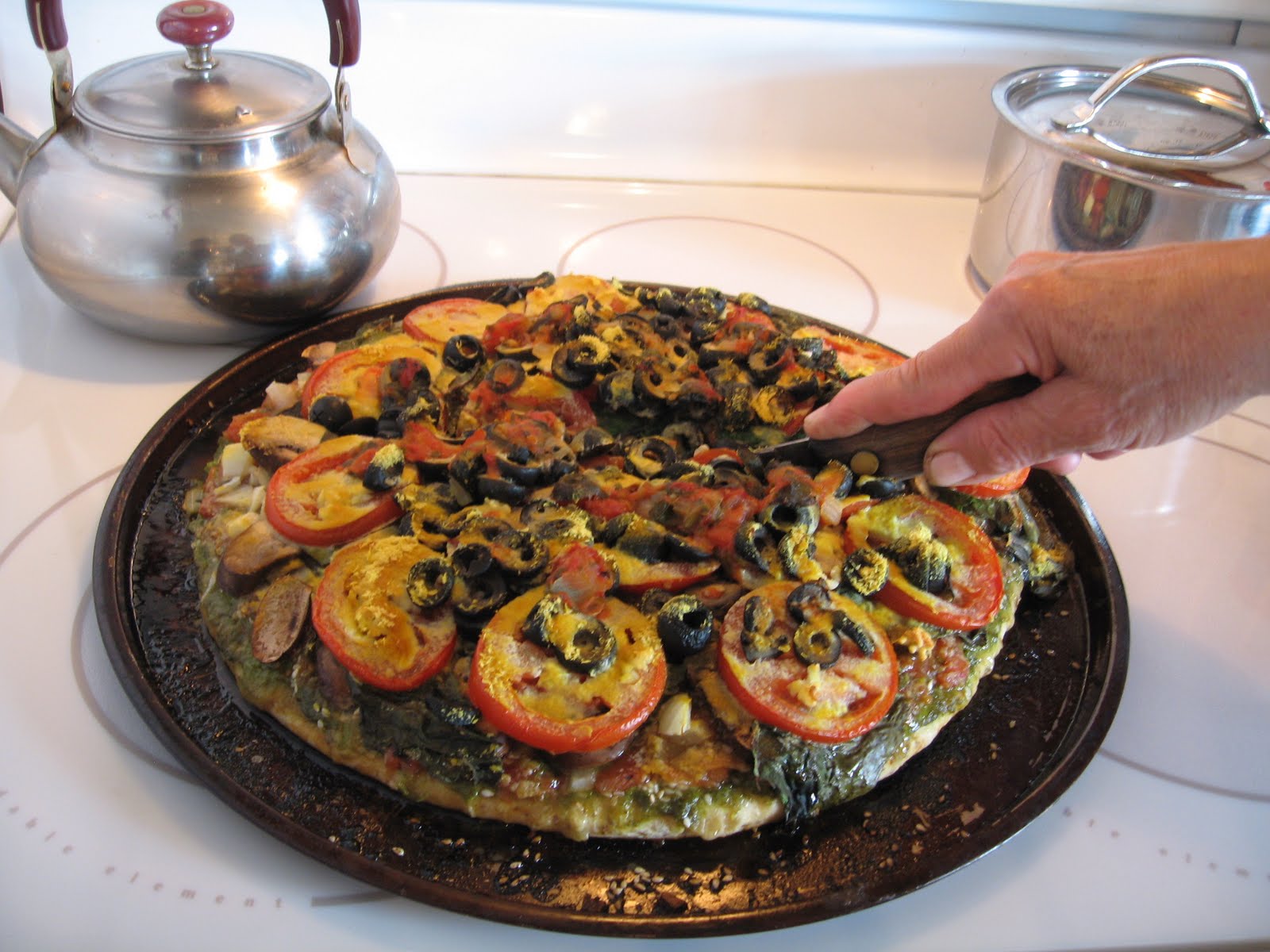
Step 5: Top the dough with pizza toppings. Pictured here the toppings were a home-made pesto-sauce (tomatoes are very acidic, and store-bought tomato sauces have citric acid!), thinly sliced zucchini, onion slices, a heap of spinach leaves over an inch thick and topped with more onion slices and tomatoe slices (I added tomatoes to my diet this summer - oh yum!). Very lightly drizzle olive oil and liberally sprinkled with fresh or dry basil, parsley, oregano, sea salt and garlic powder (early on, I had trouble with garlic and onion powders ... I wonder about their chemical processes used in making them ... research needed).


By the way, these final particular pizza toppings aren't for the candida person. People with systemic candida cannot have mushrooms (fungus!), olives (fermented plus acidic with vinegar!), sprinkled with nutritional yeast (created from a fermentation process!) instead of using cheese (a dairy derivative and loaded with aged bacteria!).
Step 6: Bake the pizza for about 40 minutes at 350 degrees.

This crust has many uses. I've used it for making crusts for vegie pies and quiches, for making hand-held stuffed pies and calzones (add a couple tablespoons of flaxmeal for thickener or the dough with break), and also for quick wrappers for vegetarian "pigs-in-the-blanket". I've never tried it for tortilla-like salad shells but I supposed it could work quite well. For a sweeter crust, use coconut oil and eliminate the herbs, possibly adding cinnamon and cloves.

Tuesday, September 27, 2011

Letters to a Friend

The first letter to a friend who had alluded to poor health and resulting poor quality of life... She seemed like she wanted to "talk" but was afraid to "open up" about her problems. Being sick is isolating, and causes such confusion, and so I wrote:
Dear R~~ 
...I've been having my own bear of a time. I got dog sick 2 1/2 years ago - systemic candida and the first year it almost wiped me out. I was so sick I couldn't even concentrate, the pain level was horrendous (the whole body but esp the rib cartilage which was breaking apart) and the flaming docs told me to see a psychiatrist cuz the blood work was coming back pretty good ... and not one, and I saw like 35-40 docs, recommended vitamin testing, which eventually proved extremely low vitamins A & D. Osteomalacia, aka adult rickets, fit(s) my bone and muscle syptoms perfectly! And I had seen close to 8 bone doctors and they were so focused on X-rays and non-vitamin testing that they could not give any kind of diagnosis or even a hint! Disgusting!). Long story but now I'm my own doc and am slowly slowly improving. I've learned tons about disease and diet control, and I eat only food that I prepare .... and I feel great! The down-side of all this is that my traveling days are temporarily at a halt cuz I'm so dependent on simple foods that are both gluten free and extremely low glycemic and also only those I prepare. I refuse to let that get me down. I MUST think positive .... and so I just focus on: I feel great! BTW, my favorite word is PROACTIVE :)
My friend responded in a way that I had felt when I was so sick the first year. She was so confused at her symptoms, and so missing her healthy youth. We're the same age and we're both too young to be so sick. She told me she's been diagnosed with fibromyalgia, osteoarthritis and these are complicated by spinal and head injuries from a car accident in which she was seriously rear-ended. All her problems were results of outside forces and she's depressed and feels helpless about the tailspin of her former good health. I do know from experience that pain can be managed by a careful diet. I've been managing my systemic candida difficulties with a strict, strict anti-candida diet. People might deride me for having a very limited food selection and say that "I'm not living", but my answer is to smile cheerfully ... and keep toting my lunch to restaurants to eat with friends (or just sitting with friends but not eating). To eat the wrong food is NOT an option. It just plain makes be sick -- first grumpy, then depressed and then the aches start. And so my reply is, "I AM living, and I'm living very well MY WAY."
Dear R~~

I'm sooo glad I decided to respond to your comment! My studies on health have taught me tons about fibromyalgia and osteoarthritis, which btw are related. Careful eating for those is essential for improvement. (MDs dispute it but they were trained by pharmaceutical companies to believe in pharmaceutics, surgery and other invasive procedures to heal - what a load of crap, excuse my language, but I've heard all sorts of nonsense from them concerning my "problems" and early on I even tried some of their treatments cuz I was desperate but I had some horrible reactions to some of their chemical-drugs ... well, hello, bacteria in general and especially candida love chemicals!).

Anyway, let me explain about what I've discovered to be big causes of fibromyalgia, osteoarthritis, rheumatoid arthritis, multiple sclerosis, Crohn's disease, celiacs disease and the other autoimmune diseases: bacteria. [It seems diff kinds of bacteria or at least bacteria located in diff places in the GI tract are one of the big sources of autoimmune health evils. Nutritional imbalance is another, but then, bacteria overgrowth causes nutritional imbalances, and vice versa ... (I wish someone would do some specific research on this particular disease-bacteria link!) I've only found data on three specific diseases related to three specific bacteria so far: Crohn's disease, a low grade fever caused by a can't-remember bacteria in the lower GI tract, Grave's disease which I was diagnosed with 6 yrs ago & forgot the bacteria also but it's definitely one of many forerunners for systemic candida, and Parkinson's disease which my dad has & is often caused by h.pylori]. The overgrowth of bacteria can come gradually or in my case just explode suddenly within the body.

I'm not totally sure my bacteria IS the much talked about candida albicans (there are about 17 kinds of candida) since it's self-diagnosis and when I've pointedly asked 3 docs in diff fields and who knew my long sick-history, they all told me in quick reply and without any testing "you don't have candida". I knew that doctors don't regard candida as a problem since everyone from about 6 months old has the bacteria (although not out of control). But total disregard to it causing a problem?! Ergh! So much for getting a specific test for diagnosis!!! Docs have been absolutely no help! Many docs also told me I was too food focused and to stop talking about food - hello, that's where my symptoms were coming from!!! So, it took me 1 1/2 years to systematically self-diagnose myself, and when I put myself on the strictest of candida diets b/c any kind of sugar, even small amounts of fruit sugar or root vegie sugar, set me off, within three days my pain was minimized and I could start thinking more clearly!!! Wow, the brain fog was clearing up!!!

Anyway, according to my research bacteria is what's causing the auto-immune disease(s). So to combat the bacteria, you have to stop feeding it, but of course you need to feed yourself or you'll die so you have to nourish yourself on the simplest, lowest-glycemic foods and foods that are not glutinous to your compromised GI track. You have to also eliminate all processed foods - canned, packaged, instant - and eat whole foods and vegetarian foods (meats have hormones out the wahzoo and dairy should never enter the mouth as its a known bacteria carrier).

I hear you when you say you just have no energy to do much and it's easier to go out to eat. I spent about 3 months barely dragging myself home after classes and lying on the floor. Thank goodness for my cat. She knew something was terribly wrong and after I'd lay there for a couple of hours, she'd scream in my face and I had to take care of her ... she was what kept me moving. It was awful cooking during that time and I had almost no ability to plan my classes - 3 hours to plan a lesson that would formerly take me 10 minutes! I got a crock pot and would put beans (only low-glycemic beans: black beans, lentils and chick peas) in it in the a.m. and add some vegies when I got home - eat 1-2 hours later and pack leftovers for lunch the next day. Rice cooker was good for brown rice, 율무 (job's tears), quinoa, sorghum grain, buckwheat and occasionally millet (no barley, oats, wheat, rye or triticale). Breakfast was made in the blender with a massive pile of green vegies (no root vegies cuz of starch, no tomatoes cuz acidic, no peppers cuz of inflammatory capsicum, no squash except zucchini cuz of starch and higher glycemic index ... no fruit for months but 1/2 a green apple later on). Anyway, my kitchen appliances saved me working in the kitchen.

Honestly, R~~, I think you should try the diet for 1 week, and if you feel a difference in the pain level and clearer in the head, you know you're onto something helpful. You have to remember, though, that you have to be strict during that week (no gum, candy, coffee or tea except peppermint tea. It's best not to eat between meals; just give your GI track time to clean out and if you continue with the diet it can heal, at least to some degree.) The first week was hard cuz I didn't really know what I was doing ... had to keep getting stricter and learn by trial and error [not much on the internet for the strict candida diet]. But it's been 10 1/2 months for me ... and like I said: I feel great! BTW, my symptoms before were wild beyond what I mentioned earlier - had bad symptoms for multiple sclerosis (MS) and rheumatoid arthritis (RA). They're closely related among the autoimmune diseases as is fibromyalgia. Those symptoms just niggle a bit, but with the diet, I am in control; without the diet, they are in control.

... Another secret I've discovered is to stay focused on others and not yourself. Wow, cuz other people's probs are HUGE in comparison with mine ... haha, but then you know, I like my word: PROACTIVE!