Showing posts with label fingernail analysis. Show all posts

Friday, August 7, 2015

Fingernail Analysis, part III

8 Health Warnings Your Fingernails May Be Sending 

Source
Your eyes may be the window to your soul, but, in many ways your, nails are the window to what’s going on inside your body. Here are some common nail problems and what they mean: 
Take a good look at your fingernails and you may notice subtle variations in the texture or color; white spots, a rosy tinge, rippling or bumps in the surface to mention a few. These imperfections may not look like much to you, but it’s more important than you might think to maintain healthy fingernails. That’s because to the trained eye, nails can provide valuable indications about your overall health. 
Hold a hand level with your nose about a foot out from your face and scrutinize each one. Look at the grooves, curves, ridges and dips. Notice how thick or thin they are and if there are any stark differences. Are your nails are chipped or broken. Make a note of the color of the nail itself, the skin under it as well as the skin around the nail. You need to get into the habit of knowing your nails and any changes that can occur. Changes are a good indication of the onset of several health problems. Here are 8 of the most common nail issues:
1. RIDGES: Healthy nails should have no obvious ridge lines and should be virtually smooth to the naked eye. Ridges can indicate several health issues including:
  • Inflammatory arthritis
  • Iron deficiency
  • Lupus (with red lines at the base of your nails)
Don’t ignore these ridges by using a nail buffer to smooth the surface – these are warnings to be noticed!

2. THICK NAILS: It is fairly obvious is you have a thickening of the nails and they can have several causes including:
  • Thick/separated nails can indicate thyroid disease or psoriasis
  • Thick/rough-surfaced nails can be a sign of fungal infection
  • Unusually thick nails could be a symptom of a circulation problem
  • Thick nails alone could even signal lung disease
Thickening is fairly easy to notice when it first appears but please note that allergic reactions to some medications manifest themselves as thick nails!

3. DISCOLORED NAILS: A healthy nail bed should be pink with a slight pinky white moon shape at the base. Streaks of any other stronger shades or colors can indicate health issues, as can nails that are tinged by other colors such as:
  • Dark stripes towards the top of the nail are associated with aging and congestive heart failure
  • Blueish tinge to the nails can be a sign of depleted oxygen levels in your blood
  • Green nails are usually a sign of a bacterial infection
  • White nails indicate liver disease, such as hepatitis
  • Red streaks on the nail bed could be a warning of an infection of the heart valves
  • Dull nails in general mean a deficiency of vitamins
Inspect your nails when they are clean and you should know when the color changes.

4: PITTED NAILS: Sometimes small dips can just be the result of a bash to the hand in general, but sometimes more attention should be paid as they can be a symptom of:
  • Zinc deficiency (usually the pit will form a line across the middle of the nailbed)
  • Connective tissue disorder
  • Psoriasis
  • Alopecia areata, which is an autoimmune disorder that results in hair loss
Learn the difference between an injury related imperfection which should not last too long, and a potential disease related imperfection which will not clear up.

5. DRY AND BRITTLE NAILS: Healthy nails should not require cuticle oil and moisturizers as they should maintain themselves. Excessively dry or brittle nails can be a sign of a hormonal balance problem or a bacterial infection.
  • Thyroid disease can result in brittle, dry nails that also crack and split very easily
  • Fungus can cause nails to become dry or even crumbly and is a common problem
Both these potential problems can be treated and the nails will return to good health once a full growing cycle has passed (hand nails grow at about 1 mm per week so on average the full life cycle of human nail is about 6 months). 

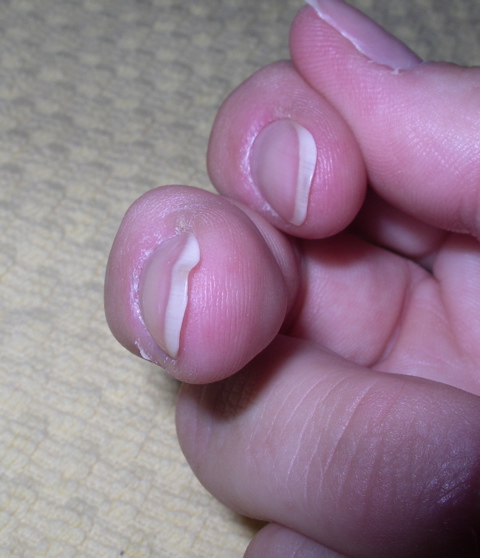
6. CONCAVE OR SPOON SHAPED NAILS: What are known as ‘full spoon’ nails are very soft and curve upwards with the dip being pronounced enough to hold a drop or two of liquid. This usually is an indication of:
  • Heart disease
  • Iron deficiency (usually from anemia)
  • Hypothyroidism
  • Hemachromatosis, which is a liver disorder caused by the body absorbing too much iron
If medical intervention clears up the root cause then the nails will return to a normal healthy shape with time.

7. CLUBBED NAILS: This is when the skin around the nail bed can appear inflamed or unusually puffy. This can mean:
  • Liver disease
  • Lung disease, especially if you already have trouble breathing
  • Inflammatory bowel disease
  • AIDS
Most of these health issues will often have already given you other symptoms but the corresponding nail condition can help with diagnosis.

8. SPLIT NAILS: Often our nails split if we have injured them. But when no trauma has occured but the nail flakes away layer by layer it can be a result of several issues:
  • Chronic malnutrition
  • Deficiency of Vitamin C, folic acid or proteins
  • Split nails together with a pitted nail bed can indicate psoriasis
Eating a healthy well balanced diet can eliminate many of these causes. 

Obviously our fingernails will not be the only signs of these diseases, but they can provide confirmation or else the motivation to seek further medical attention.
Strong, healthy nails reflect a strong, healthy you. Share with anyone you know may need to pay attention to their nails.
To read the former postings on fingernail analysis, go to: 

Friday, December 13, 2013

Underactive Thyroid?

By Donna Gates, Body Ecology

What Role Does The Thyroid Play?


The thyroid gland is a small butterfly shaped gland that sits just below the thyroid cartilage. The hormones secreted by the thyroid help to regulate heart rate, maintain healthy skin, and play a crucial part in regulating your metabolism.

The thyroid also works to:
  • Lift your energy
  • Regulate your core temperature and warm your body
  • Activate your immune system
It can also tell the body to slow down. Sometimes the thyroid slows down so much that it becomes underactive. This is what is known as hypothyroidism. When this happens, the thyroid gland does not do its job, and the whole body suffers as a result. As common as hypothyroidism is, the detection and treatment of it are getting a second look by doctors.

What Symptoms Does An Underactive Thyroid Produce?


When the gland is sluggish (hypothyroidism), your body will give you some fairly obvious signs.
Some common signs include:
  • Edema, or swelling in the legs, arms, or face
  • Abdominal weight gain
  • Cold hands and feet. Also, check if the nail beds are overgrown with fungus
  • Increased susceptibility to the common cold and flu. Or, a respiratory infection that hangs around for months
  • Dryness, which shows up in loss of hair, brittle nails, constipation, and achy joints

What Does It Mean When Your Symptoms Persist?


  • You still feel like there is something wrong with your energy levels and basal body temperature?
  • You continue to lose hair and gain abdominal weight?
  • You begin to feel better and then start to feel just as crummy as before the medication, even though you now take it religiously?
  • Do you feel like you're always the first to catch a cold? An increased susceptibility to the common cold and flu is one possible sign of an underactive thyroid.

5 Clues That May Indicate Your Thyroid Is Underactive


Doctors are now investigating why thyroid tests may appear normal, but the thyroid itself may still be dysfunctional. Seeing a pattern will help you determine if your thyroid medication is properly treating an underactive thyroid, or if more diagnosis is necessary.

1. Edema, which is the abnormal accumulation of fluid beneath the skin. The edema that occurs in hypothyroidism is the “non-pitting” form of edema.
  • “Non-pitting” means: You press your finger into the flesh, and it bounces right back and leaves no mark.
  • This is called myxedema, which is specifically associated with low levels of thyroid hormones.
  • Myxedema is swelling of the arms, legs, and face.

2. There is persistent weight gain, especially around your torso, that you just can’t lose no matter how frugal you are with calories.

Dr. Roby Mitchell tells us that thyroid hormones help insulin move glucose from blood into the cells. “When thyroid levels are low, more insulin is needed to maintain normal glucose. More insulin means more fat cell hyperplasia, which shows up as increased fat deposition.” The adrenals lose strength when the thyroid is underactive, which also slows down metabolism.

3. Cold hands and cold feet may mean lack of blood flow.

Lack of blood flow to the extremities, like your hands and feet, can also show up as chronic fungal infections. This is because the essential nutrients carried in the blood do not reach the extremities as frequently. Low thyroid activity is associated with too much homocysteine - an amino acid associated with heart disease, poor blood flow, and stiff vasculature.

4. Nagging infections could point to an underactive thyroid.

Dr. Mitchell points out that because beta-carotene depends on thyroid hormones in order to convert into vitamin A, beta-carotene can build up in the body and cause yellow skin, especially in the hands. The official name for this is called carotoderma.

Vitamin A plays an important role in immune system health. What happens when the body cannot convert beta-carotene into vitamin A? The body may become more susceptible to infections, or it simply may not have the strength to kick a bug.

5. Excessive hair loss, painful joints, and other signs of dryness.

Iodine and Thyroid Function


Because there are so many pathways to an underactive thyroid, including autoimmune hypothyroid, be careful when supplementing with iodine. Iodine, while central to the production of thyroid hormones T3 and T4, can actually make some hypothyroid conditions worse. This is because iodine speeds up the production of a thyroid enzyme. If the body has developed autoimmunity to this enzyme, which happens in the case of Hashimoto’s thyroiditis, then this will increase the inflammatory cascade.
  • Iodine is not a cure-all.
  • Diagnosis, knowing the mechanism responsible for an underactive thyroid, is paramount.
Using iodine to address a thyroid condition does not take into account autoimmune hypothyroid. It also does not address diet or lifestyle, which can make a tremendous impact on thyroid hormone levels.

Testing for Hypothyroidism Can Be Tricky


A major issue has erupted in the medical community. Many doctors are now disagreeing over what tests should be done to check thyroid function. Traditionally, TSH, Thyroid-Stimulating Hormone that is released from the pituitary gland in the brain, would be checked along with the two thyroid hormones it produces, T3 and T4.

However, it has become commonplace to only test for TSH, and that is only one part of a very detailed picture. There are many other mechanisms at work in thyroid health.
For example, healthy thyroid activity relies on:
  • Stable levels of other hormones, like estrogen and progesterone. Too much estrogen, such as from the birth control pill, will create too many thyroid-binding proteins.
  • A healthy immune system. Autoimmune hypothyroid can be missed by TSH blood panels.
  • Beneficial bacteria in the gut. Antibiotics wipe out these good microbes, which account for around 20% of the conversion of T4 to usable T3. (1)
  • An uncongested and healthy liver. The liver converts over half of T4 from the thyroid into usable T3.
  • Good adrenal function. Adrenal fatigue can slow down the function of the pituitary and hypothalamus in the brain. These three glands are a part of what is called the HPA axis (hypothalamus-pituitary-adrenal axis). An alert and healthy pituitary is essential for good thyroid function.
Clearly, with so many pathways available for the production and conversion of thyroid hormones, there are a lot of opportunities for something to go wrong.

Many people are diagnosed with this condition and given thyroid medication. Sometimes, this medication will show improvements in lab analysis as hormone levels fall into normal range. But many people still have symptoms.

Tips For Treating An Underactive Thyroid


  1. Work with a qualified health care practitioner
  2. Populate your gut with good microbes. Remember, gut flora convert 20% of T4 into usable T3! Eat fermented foods and drink probiotic beverages with every meal!
  3. Regulate your immune system
  4. Address any blood sugar imbalances
  5. Diet and lifestyle can drastically affect your adrenals, the HPA axis, and the health of your thyroid; does your current diet and lifestyle support a healthy thyroid?
This article was taken in its entirety from Food Matters.

Saturday, August 4, 2012

More about Fingernail Analysis

Some of this data expands on an earlier posting on analyzing health by studying the fingernails, and some of this info is overlapping, but it complements the earlier data in many ways and in some ways provides more insightful information about the nail aberrations. To view the online source of this info, click here.

The body's fingernails and toenails are like 20 mini mirrors reflecting one's overall health. Changes in the body, invisible beyong the skin, layers of muscle and fat are somehow made visible through the color changes of the nails, the shape and the overall condition. Therefore, as dermatologist Amy Newburger, a senior attending pysician at St. Luke's Roosevelt Medical Consortium in New York City says, changes throughout the body that are otherwise invisible can sometimes be first seen in the nails.

In many cases the fingernails can give a better understanding of what's happening in the hidden body because toenails can be affected from walking, wearing tight shoes, and therefore have less circulation, which can affect toenail change. On the other hand, it's my - the blogger's - opinion that analyzing both fingernails and toenails is necessary as toenails, due to their being further from the heart and prehaps first affected by slower circulation or more likely to harbor fungus that is less frequently seen in fingernails, could tell a mighty story of one's health. So, looking at BOTH the fingernails and toenails is necessary for getting the bigger picture of one's overall health.

Wearing fingernail and toenail polish can change the appearance as does buffing. For this reason, if one is wanting fingernail and toenail analysis the person must have nails (for some time) that have been un-affected by the chemicals which are put on the nails. In a similar way, when one undergoes an operation, having polish-free fingernails (and sometimes toenails) is a requirement of hospitals. The main reason for operating personnel, however, is to note the change of color of the nail bed which can tell if the patient is getting proper amounts of oxygen while under aenesthesia.

For more serious nail analysis, the following 9 clues will explain a visual or tactile affect of the nail and then explain what could the aberration possibly be telling the individual.

Clue 1: A black line

Look for: A black discoloration tappearing in a straight vertical line or streak and growing from the nail bed, usually on a single nail. About 75% of cases involve the big toe or the thumb, according to a review in the British Journal of Dermatology. Especially worrisome: a discoloration that's increasing or that's wider at the lower part of the nail than the tip. "That tells you that whatever is producing the pigment is producing more of it," says Newburger. Also beware when the skin below the nail is also deeply pigmented, says podiatrist Jane Andersen of Chapel Hill, North Carolina, a spokeswoman for the American Podiatric Medical Association.

What it might mean: Melanoma, the deadliest form of cancer. People with darker skin are more vulnerable than Caucasians to subungual melanoma (melanoma of the nail bed), but darker-skinned races also have more dark lines in nails that are benign, according to a 2004 report in American Family Physician.

Next steps: Always have a doctor check out a suspicious black line on the nail quickly because of the high skin cancer risk. A black line on the nail may also be caused by a harmless mole or an injury. A biopsy can confirm melanoma.

Clue 2: Small vertical red lines

Look for: Red (or sometimes brownish red) streaks in the nail. "They look like blood or dried blood," Anderson says. These are known as "splinter hemorrhages" because they look like a splinter but are caused by bleeding (hemorrhage) under the fingernail or toenail. They run in the same direction as nail growth.

What it might mean: Heart trouble. The "splinters" are caused by tiny clots that damage the small capillaries beneath the nail. They're associated with an infection of the heart valves known as endocarditis. Don't panic if you see one though: Sometimes an ordinary injury to the nail can cause a splinter hemorrhage.

Next steps: No treatment is needed for the splinter hemorrhage itself. A doctor can evaluate and treat the underlying cause if it's heart-related.

Clue 3: Wide, "clubbed" nails

Look for: Uniformly widened fingertips or toes - they appear to bulge out beyond the last knuckle - where the nails have widened, too, so that they curve down and appear to wrap around the tips of the finger like an upside-down spoon. (Normal nails are narrower than their base fingers.) These extra-wide nails are called "clubbed" nails.

What it might mean: Clubbed nails are a common sign of pulmonary (lung) disease, Newburger says. Although the nails' odd shape develops over many months to years, people are often unaware of the underlying condition, which can include lung cancer.

Next steps: If you haven't had a physical exam lately, consider one, especially if you have other symptoms such as coughing or shortness of breath.

Clue 4: Spoon-like depressions

Look for: Nail beds that have little dips in them, an effect called koilonychia, or "spooning." "If you put your hand flat on the table, the spooned nails look like they could each hold liquid," Newburger says. The nails will also be unusually pale or stay whitish for more than a minute after you press gently on one. (Normally it would turn white for a second or two before returning to its original pinkish color.) The moons at the base of the nails may look particularly white.

What it might mean: Iron-deficiency anemia. Spooning can also be seen in the nails of people with hemochromatosis, or "iron overload disease," a condition usually caused by a defective gene that leads to too much iron being absorbed from the gastrointestinal tract. Other symptoms for both conditions can include fatigue and lack of energy, or they may be symptomless.

Next steps: A complete blood count can diagnose anemia, and a physical exam might pinpoint the cause of iron problems. Iron supplements and dietary changes are often prescribed as first-line treatments for anemia.

Clue 5: Rippled, pitted nails

Look for: Tiny indentations or holes in the nail bed called "pits." The nail may also appear to be rippled rather than smooth. (You can also feel these abnormalities by rubbing your finger across the nail, which is normally as smooth as the inside of a seashell.)

What it might mean: Psoriasis. Between 10-50% of patients with this common skin disease have pitted, hole-pocked nails, according to a 2000 report in Primary Care. So do more than three-fourths of those with psoriatic arthritis, a related disorder that affects the joints as well as the skin. More rarely, Reiter's syndrome and other diseases of connective tissue show this symptom.

Next steps: A doctor can prescribe medications to treat the underlying conditions. The nail bed can often be restored in psoriasis when the treatment starts early.

Clue 6: Brittle nails

Look for: Peeling, splitting, or easily cracking nails. Sometimes vertical ridges mar the surface, too. These telltale wrecked nails are sometimes called "hypothyroidism nails."

What it might mean: Thyroid disease. Hypothyroidism, or underactive thyroid, occurs when the thyroid gland doesn't make enough thyroid hormone. (Typically a patient's hair is also thin and brittle.) Metabolic functions throughout the body are disrupted, including the delivery of moisture to the nails. Pale, dry skin and hair that may fall out are related signs. Hyperthyroid (overactive thyroid) diseases, such as Grave's disease, may also cause brittle nails.

Next steps: Skip the over-the-counter nail strengtheners for persistently brittle nails and get thyroid levels checked; if thyroid disease is the cause, it's important to treat the root problem.

Clue 7: Nails that seem to be "lifting off"

Look for: The nail itself separating from the nail bed, which is the layer of skin directly under the nail. This effect, known medically as onycholysis, often begins at the fourth or fifth fingernail. Toes can also be affected. It's also called "Plummer's nails" (after the physician Stanley Plummer, who described them in 1918) or "dirty nails," because debris can accumulate and be seen.

What it might mean: Thyroid disease. Hyperthyroidism, in which too much thyroid hormone is produced, can cause excessive nail growth and lead to this deformation. Plummer's nails tend to occur in younger patients rather than older ones.

Next steps: Other hyperthyroidism symptoms to be aware of include fatigue, difficulty concentrating, increased appetite, weight loss, sweating, hair loss, itching and protruding eyes.

Clue 8: Depressions running across the nail horizontally

Look for: White ridges running across the width of the nail bed. These so-called "Beau's lines" (after the French physician who described them) can occur in all or just one nail; if in all nails, they're at about the same place on all of them. They're actual ridges in the nail plate itself.

What it might mean: Diabetes, psoriasis, Raynaud's disease -- or just a trauma to the nail. Beta-blockers and drugs used in chemotherapy can also produce Beau's lines. Some people develop them simply as a result of aging.

Next steps: Consider this effect just one piece of a puzzle. Nails grow about 1 mm every six to ten days, so doctors use this measurement to estimate when the problem might have begun.

Clue 9: White bands running across the nail horizontally

Look for: The white-colored bands, known as "Mees' lines," run transverse (parallel to the white tips of the nails). They may affect one nail or several, occurring at about the same spot on each nail. Because the problem is in the nail itself, the line moves forward as the nail ages - allowing doctors to date the time the problem began.

What it might mean: Arsenic poisoning! Hair and tissue samples should be tested to verify. It's pretty rare these days, Anderson says, but worth knowing about.

Next steps: Make an appointment to see a doctor - and avoid eating anything you don't prepare yourself!

Wednesday, August 1, 2012

Fingernail Analysis

According to Natural Health Techniques, a good practitioner trained in fingernail analysis can look at a patient’s nails and be able to tell which organs are weak and which are healthy (not to be totally reliable).  Since the nails are the last to receive oxygen because they are the farthest from the heart, they are often the first to show signs of disease processes. Each finger reflects what is going on in specific organs.

What each finger and corresponding nail is attributed to:

  • Thumb: what is going on in the brain, excretory system and in the reproductive organs
  • Index Finger: what is going on in liver, gall bladder or nervous system
  • Middle Finger: what is going on in the heart and circulation
  • Ring Fingers: what is going on in the reproductive organs and the hormonal system
  • Little Finger: what is going on in the digestive system
To analyze, look for abnormalities in the lunulae, color, texture and markings, shape, and pliability.

Nail Fungus

fingernailCuticalYeast 218x300 Fingernail Analysis
Middle finger - nail cuticle showing yeast challenge
Easy to miss as most practitioners look at the fingernails and not the toenails where nail fungus is most common. If having nail fungus, the safest, cheapest and most effective treatment is to apply Vick’s Vapo Rub once a day on the entire nail. Do this every day until the entire nail grows out, about 2 1/2 - 3 months. Clip the nail and keep it as short as possible during this process. The Vick’s has a high concentration of camphor in it which penetrates the nail and oxygenates the area. Fungus can’t live with that extra oxygen. Many times nail fungus is a sign that the person has a deep-seated yeast infection and has had this for years. 

Yeast is also suspected when the cuticles look reddish or have hang nails or people pick at them. But it can also be that they have their hands in chemicals or agents that dry out the cuticles so a good history is necessary when looking at the nails and anything else really.

If yeast infection exists, the preferred treatment for Natural Health Techniques (NHT) is Myrrh gum powder capsules. Myrrh gum is an herb that works for the greater portion of the population. Before taking it, figuring out the dosage (usually 1-3 capsules/day) is needed, and it should be taken for several months to kill the yeast from the inside out. This way the nail fungus will be gone permanently. Myrrh is not a good choice for children, but for adults it is the most common treatment for adults at NHT.

The Lunulae

(Lunula, singular; lunulae, plural) The lunulae are those little white moon things at the base of the nail. There should be 8 of these. The lunulae on the little fingers should be missing according to Eastern Medicine Philosophy. The one on the thumb nail should be 25% or less than the total length of the nail from base to flesh line at the top.

If the thumb lunula is too large the heart and circulation is working overtime and eventually this overworks the heart. The person may be exhibiting high blood pressure. Other signs that the heart is working overtime would be the presence of “heart line” on the ear lobe (a line just above the lobe itself) and a pointed tongue. If the tongue is red at the tip, there is a more serious involvement of the heart.

Lunulae on the little fingers also is a sign that the circulation is working overtime (especially in the digestive area). High blood pressure may be the cause as well.

Fewer than 8 lunulae:  Many rule-outs here such as poor circulation, anemia, fatigue, not enough oxygenation or exercise, heart disease, imbalanced nervous system, numbness, protein deficiency, Vitamin A deficiency or being weak-spirited (low life force or “chi”). Yes, taking deep breaths is important, for more read the Basics of Breathing handout and/or practice some meditation.

Lunulae are red or blue or there is a reddish or bluish tinge just above the lunulae but not on the rest of the nail:  Heart disease, heavy metal poisoning or lung disease.

Shoot-like things emanating from the border of the lunulae: This not very good sign can mean thyroid problems or cancer; many men with this on their thumb nail have been diagnosed with prostate cancer or have had their prostate removed due to cancer. It is reversible with proper treatment. PSA (Prostate Specific Antigen) test and a Thyroid panel can be taken to verify any of these abnormalities.

An interesting note: You can tell often if a person is right-handed or left handed because the lunulae will be larger (or there may be more of them) on the hand that is used more often.

Nail Color

Nail color can be grouped into black, blue, brown/copper, green, blue-green, gray, yellow, pale, purple or red groups. Each color means something different and there are many rule-outs for each color.

Look for the color in general. Nails should be pink. When pressing down on the nail, the circulation should return within one second. This is called Capillary Refill Time. A change in nail color from trauma is not to greatly concerned about, but when nails without trauma look different, then some concern is in order.
  • Black:  anemia, B-12 deficiency, bacterial infection, chronic kidney disease, adrenal gland problems, liver disease, cancer or melanomas, silver deposits (heavy metals), trauma
  • Blue:  atherosclerosis, blood is too thick, liver disease, COPD (lung disease), copper or silver poisoning, decreased hemoglobin, drug reactions, gas poisoning, heart disease, hepatitis, high platelet counts, increased cholesterol, inflammation, kidneys with clogged arteries, lupus, prior strokes, rheumatoid arthritis, blood clots
  • Green:  allergies to cleaning agents, bacillus infection, localized fungal infection, serious emphysema 
  • Brown or Copper:  arsenic or copper poisoning, fungal infections.  
  • Grey:  arthritis, edema, malnutrition, post-operative effects, glaucoma, lung problems, emphysema, cardio-pulmonary disease
  • Yellow:  bleeding, diabetes, digestive problems, liver disease, hyperthyroidism, too much carrot juice, lymphatic problems, nail fungus, poor circulation, respiratory problems, vitamin E deficiency, fluid retention in the lymphatic system 
  • Pale or White:  anemia, candida (yeast), low life force, overall mineral deficiency, heart or lung problems, hemorrhage, hookworm infestation, kidney disease, liver disease, malnutrition, ulcers 
  • Purple: oxygen deprivation, circulatory problems, congenital problems 
  • Red: brain hemorrhage, heart disease, high blood pressure, lung disease, stroke, carbon monoxide poisoning
Nail Texture and Markings

The most common are vertical ridges and split nails, horizontal dips, red bands at the tips, yellow tips and white spots. There are others, however.

Vertical Ridges and Split Nails:  adrenal gland problems, arthritic tendencies, asthma, broken heart, bronchitis, calcium deficiency, chronic fatigue, chronic inflammation, chronic stress, depression, emotional trauma, excretory system conditions, hyperactivity or overexertion, iron deficiency, kidney problems, laryngitis, nervous problems, poor digestion/absorption in the small intestine, chemicals from food, dieting, protein deficiency, respiratory problems, unhappiness, vitamin A deficiency, yeast and other fungi, lupus, chemo or radiation side effect, drugs or prescription use
  
FingernailLiverLines 258x300 Fingernail Analysis
Fingernail red lines at the tips
If ridges appear on all the nails, the intestines are not effectively assimilating the foods. For these cases, at NHT ionic or colloidal minerals are prescribed right away. They are supposedly the best, most easily digested vitamins and minerals on the market. 

Horizontal Dips:  poor circulation, picking at the nail bed, heart disease, stress, lack of essential nutrients, trauma

Red Bands at the Tips:  allergies, liver overload, inflammation of the gastro-intestinal tract
 Yellow Tips: liver problems, melanoma, poor digestion, smoker

White Spots: kidney or hormone imbalances, zinc deficiency, calcium deficiency, Vitamin A deficiency, excessive chemical or drug use of drugs processed through the kidneys, prostate or impotence problems, genital diseases such as chlamydia or syphilis

Nail Shape

The most common problems seen at NHT are short small beds, wide clubbed beds (clubbed means that the nails curve downward), and clubbed nails.

Short Small Beds: heart disease - for this NHT recommends Standard Process Cardio-Plus (a protomorphogen) to rebuild the heart

Wide Clubbed Nails: asbestos exposure, emphysema, lung disease - NHT treats this with Pneumotrophin (a protomorphogen) for 1-2 years to rebuild the lung tissue

Clubbed: Heart disease, liver disease, lung disease

Nail Pliability

Brittle or cracked nails: Calcium deficiency, impaired kidney function, iron deficiency, malnutrition, protein deficiency, thyroid problems, Vitamin A deficiency, Vitamin D deficiency

Soft and Thin nails: adrenal gland problems, can be associated with leg cramps, poor nutrition, protein deficiency, Vitamin C deficiency


Information taken from Natural Health Techniques